
Whenever there’s a social media post about how consistent, long-term investing builds wealth, you’ll inevitably find one of these snarky comments:
“A million dollars isn’t worth that much anyway, and it’ll be worth even less by the time I retire.”
This is a more common mindset than I anticipated. Example from Reddit:
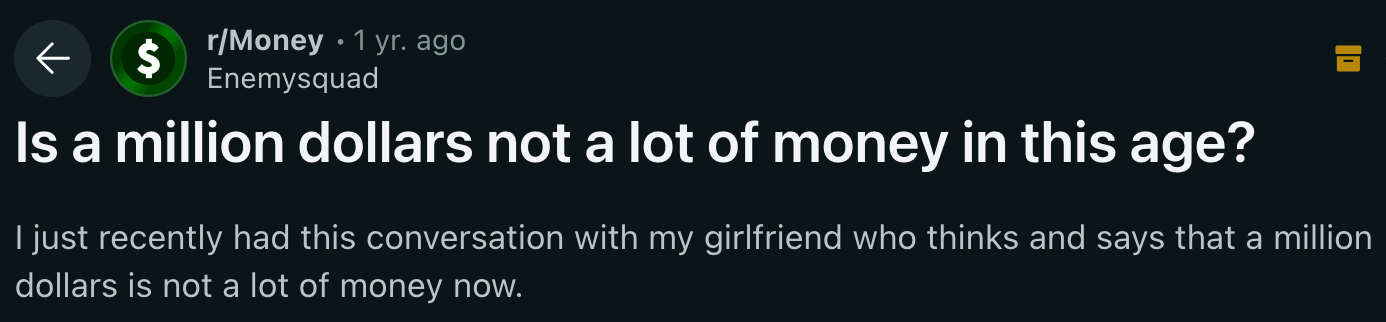
Sure, $1 million used to be able to buy more stuff, inflation has eaten away purchasing power, yadda yadda.
But $1 million is still life changing for 99% of people on earth. So why do people pan it?
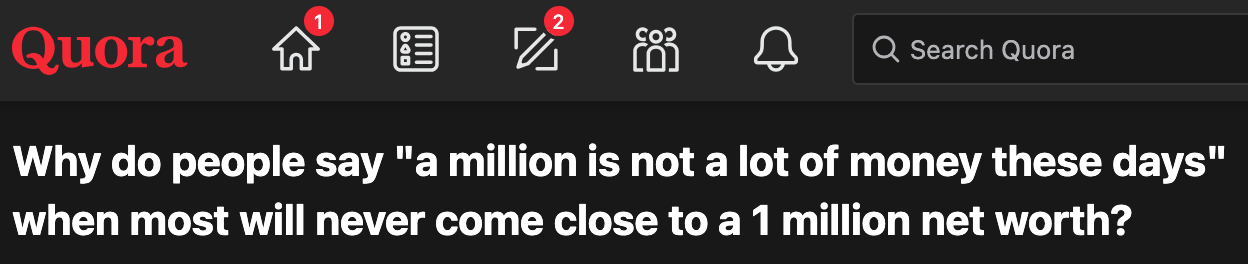
The vast majority of people talking about $1M not being enough are not millionaires.
They just want to feel right about their beliefs about money.
Being right enables you to stay comfortable without changing your beliefs.
Money for Humans examines the personal psychology around money. I help people be less wrong about money.
“Do you want to be right, or do you want to be happy?”
This is a common saying in couples therapy.
It refers to the temptation to want to win the fight.
Ironically, this ends up extending the fight or argument.
Because now you’ve pissed off the other person, so even if you’re “right” – neither of you end up being happy.
(I have absolutely no ego and have never experienced this in my own relationships, btw).
Giving up being right is a challenge for the ego. I think of the ego (okay, my ego) as a self-preservation program that wants to protect my sense of self. That includes my identity, my beliefs, and my behaviors.
Unchecked, the ego’s desire to be right becomes a sinister force that destroys personal accountability and the humility to change.
Just about everyone has deeply held beliefs about money, and changing these beliefs can be a confronting—but enriching—experience.
The ego’s favorite defense: “The System is Rigged”
When offered a straightforward, proven path to financial growth, like investing in index funds, automating your savings, and letting compound interest do its thing, what do you hear from some people?
- “The whole system is rigged.”
- “The stock market is just gambling.”
- And our favorite: “A million dollars won’t even matter by the time I retire.”
Sure, there’s a grain of truth in these statements. But let’s be real…they mostly serve as emotional shields, protecting the ego from this uncomfortable truth:
“Maybe I’ve been wrong about money.”
Admitting that could mean risking the familiar comfort of being right.
Certainty, even if it’s negative, feels safer than hope.
Because hope asks you to risk disappointment.
But here’s the catch: for new investors or those sitting on the sidelines waiting for the clouds to part and God to shout “it’s safe to invest!” clinging to certainty is a sure way to not build wealth.
The cost of being right
Hypothetical question: do you think Gen-Zs have a high or low home ownership rate?
If you were to only follow news headlines, you’d think that Gen-Z is only riding the poor bus. But then the data shows that Gen-Z actually has a higher rate of home ownership than millennials at the same age…

If a Gen-Z adult really wanted to own a home, they might feel unnecessary fear or guilt based on what everyone around them is saying.
For those who are in a worse financial position, it’s even more tempting to throw up your hands and say, “Why bother? I’m screwed anyway.”
“It’s easier to fool people than to convince them they have been fooled.” —Mark Twain
Absolute phrases like “never” and “always” offer a form of certainty, however negative.
But the real price of refusing to change is opportunity cost.
Investing in basic index funds has historically yielded about 8-10% annually.
A steady monthly habit of investing a few hundred dollars can grow into millions over a lifetime.
But that often feels too slow or challenging to start.
Feeling stuck? Send me a message on Substack Chat. It’s free. I got nothing to sell. Message Oz Chen
The trap of perfectionism
For perfectionists, investing small amounts regularly doesn’t feel good enough.
It doesn’t match their idealized, all-or-nothing scenario of instant wealth.
It doesn’t help that influencers flaunt their extravagant lifestyles full of private jets, supercars, and endless vacations.
Which reinforces the binary idea of wealth: you’re either extremely rich or not successful at all.
It’s easier to aim impossibly high and fail (or not try at all) than to take small, consistent, and humble steps toward financial security.
But as they say, easy choices, hard life. Hard choices, easy life.
Don’t regret being right
Out of the 26,000 regrets recorded in Daniel Pink’s massive study on regrets, “foundational regrets” was a key area.
Definition:
Foundation regrets are about not "doing the work" or not laying the groundwork for a stable and secure future.
Many foundational regrets are financial in nature, such as regrets of overspending, not saving enough money for retirement, racking up debt, or generally making poor financial decisions.
If you avoid money, consider this a permission slip to change your mind.
- “Maybe I’ve been wrong about finance.”
- “Maybe I’ve misunderstood investing.”
- “Maybe there’s another way.”
Imagine yourself five years from now.
Would you rather look back feeling righteous in your beliefs but stuck financially, or open-minded and secure, grateful for having challenged your old ideas?
Do you want to be rich, or do you want to be right?
Share this free article with a friend looking to upgrade their financial mindset