
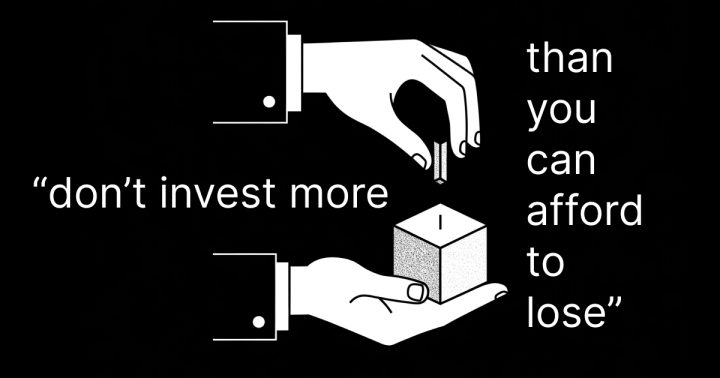
You might have heard this classic investment saying: Don’t invest more than you can afford to lose.
How does that statement sit with you?
To experienced investors, this phrase knocks hollow. “Well duh, Einstein.”
But to newer investors, this investing adage could sound confusing, if not ominous.
Well, I can’t afford to lose money, so maybe I shouldn’t invest?
Let’s break it down with a mini case study.
A new DIY Investor customer asked me how much he should invest in stocks.
I looked at his financial goals and saw that buying a house was on the list. “How soon?”
“In the next 6 months.”
Stop the train. I told him that at this point, he can stop investing beyond retirement – where he gets a match at work – and focus on saving for a down payment on a house. (This is a longer story, but FYI early DIY Investor Course customers get a free portfolio deep dive).
Key idea: anchor money to something real
I talk a lot about using tangible comparisons to make money feel real. When you can conceptualize a bucket of money as 1 month of living expenses, 1 year of salary, or 1 car, things feel more real and abstract.
The easiest thing to anchor to is the simple question: how much money do you need to live on?
(This, in a way, is the current lifestyle you don’t want to lose.)
To answer that question, we can do a bit of lifestyle math:
- Calculate your monthly spending
- Prioritize your most important financial goals (AKA home purchase)
- What’s left over after those two items determines how much you can safely invest
If your life costs $5000/month and you only have $5000 available, then it’s not a good idea to invest the full $5000 – because then your margin of safety is zero.
Investing happens within the larger context of your financial life.
Your goals come first, then we see where investing fits in.
But what if you do have some extra funds to invest, but it doesn’t feel like a lot?
Turn wasteful spending into investing dollars
I’m convinced that just about anyone can find an extra $100/month to invest.
Look at your bank transactions or receipts.
If there’s something you forgot about, or frankly don’t care about (“that meal was shit…”),
The amount that you’ve wasted is also the amount that you can “afford to lose.”
That amount you otherwise forgot about is safe to invest.
Bought a $100 shirt or a $50 meal you don’t care about? Skip it one month and invest $150.
(Better yet, return the shirt).
That’s just the tip of the iceberg. A lot of waste naturally collects in our lives – extra clothes that could be sold, unused items that could be returned, or cancelling subscriptions that no longer serve you.

Challenge: the next time you’re planning a purchase, ask yourself if you can afford to invest the same amount first. (Want to take a $1000 weekend trip? Great, are you able to transfer $1000 into an investment account first?)
Fear costs more
What if the real risk isn’t losing money, but being afraid of losing money?
Let’s paint a different picture. Imagine you do have some extra cash. You’ve done your lifestyle math, you’ve trimmed the waste, and you’re ready to invest. But then that little voice creeps in: “What if the market crashes? What if I invest right before a big drop? I’ll lose everything!”
This is a rational fear. The headlines love to scream about market corrections and bear markets. And yes, the stock market can and will go down – and up.
But in this scenario, the amount you can “afford to lose” isn’t dictated by your monthly bills or your dream house down payment. It’s dictated by your fear of losing money. That fear becomes the ceiling on your investment potential.
Here’s the twist: that fear, if left unchecked, can actually create a real loss – the loss of opportunity.
Think about it: if you let the fear of a temporary market dip paralyze you, you might keep your money “safe” in a low-yield savings account, or worse, just sitting in your checking account. Meanwhile, inflation is quietly eating away at its purchasing power. And you’re missing out on the potential for your money to grow over time in the stock market.

Ego plays a sneaky role here too. Nobody likes to be wrong, especially about money. The fear of seeing your investment balance go down, even temporarily, can be emotionally painful. We want to avoid that feeling, so we might delay investing, hoping to “time the market” perfectly – which, as any experienced investor will tell you, is practically impossible.
In trying to avoid a perceived loss – a temporary dip in your portfolio – you risk locking in a very real loss: the loss of potential growth, the loss of keeping pace with inflation, and ultimately, the loss of building long-term wealth.
How to cultivate a long term mindset
This fear of loss, this mental barrier, is often the biggest hurdle for new investors. It’s not really about the money you can afford to lose in a practical sense; it’s about managing your mindset around potential losses, and understanding that temporary downturns are a normal part of long-term investing.
Overcoming this fear and investing with confidence requires two key ingredients: knowledge and a solid long-term philosophy. You need to understand how the stock market works, why it goes up and down, and how to build a portfolio that aligns with your goals and risk tolerance. And equally important, you need a framework to keep you grounded and focused on the long game, even when the headlines are screaming “recession!”
That’s exactly why I’m developing The DIY Investor Course. It’s designed to equip you with both the practical “how-to” of investing, and the robust philosophical foundation you need to navigate market ups and downs with confidence. It’s about turning that fear of loss into a confident, long-term approach to building wealth…
The course is on presale now with $500 worth of early bird. You’ll see more official announcements of the course launch in March.

free TRAINING worth $79
Beat 90% of stock pickers by being lazy.
Learn what to buy in the stock market, how to buy, and dangerous mistakes to avoid.