

When reflecting on the question “What’s 1 thing you changed your mind about this past year?” I immediately thought of friendships.
This was precipitated by a series of moves in 2024-2025:
- I should’ve made more friends when I was in Long Beach
- OK I should make more friends now I’m back in LA.
- Who do I want to draw into my life?
- Actually, I don’t know.
That last line felt like a big gaping hole when I first said it out loud to myself.
“I don’t know who I want to draw into my life.”
Maybe it’s because my cup was so full from meeting my soulmate in early 2024.
(My favorite humblebrag ever. Past me—you did it!)
And it’s in this contrast that I saw how I was approaching friendship with obligation.
Making friends occurred to me as something I should do instead of centering myself on authentic desires.
If you have prosocial goals this year like “make more friends,” then I wrote this for you, and for past versions of me that felt so bad about this goal.

The pressure to make more friends
You’ve probably heard of theloneliness epidemic. And that we’re all supposedly in a friendship recession. Derek Thompson observed that people don’t party anymore, and are notably lonelier compared to prior generations.
Making friends is seldom an easy task, and it seems even harder today with digital distractions like social media and AI putting us more in front of screens than with each other.
Certainly all the data reinforces that having more friends is better than less.
The Blue Zone studies share that a strong social network is key to living longer. The inverse is also true: the lonelier more socially isolated, the shorter the lifespan.
Against this backdrop, you, like me, might have felt this pressure:
“I need to make more friends.”
I’ve thrown cocktail parties, created a dinner with strangers events, and often feel guilty for not initiating more, or when I have to say no to social events.
So I have lived experience with this pressure to make friends. Ironically, I’m not alone in this feeling. One of my most social friends beats himself up for “only” making 2 friends in the 7 months he’s moved to Mexico.
It’s a good intention with a negative outcome: that you have to “do friendship” like it’s a chore. And that if you don’t have “enough” friends (we’ll get to that soon), then there is something wrong with you.
Personal example:
There are some friendly acquaintances I’ve come to see here and there in LA, at the pickleball courts, and even in my apartment building. Some people have mentioned we should hang out sometime and I have done the same. Many of these conversations have either dropped off, with neither party following up.
This creates an open loop that my problem-solving mind just wants to close.
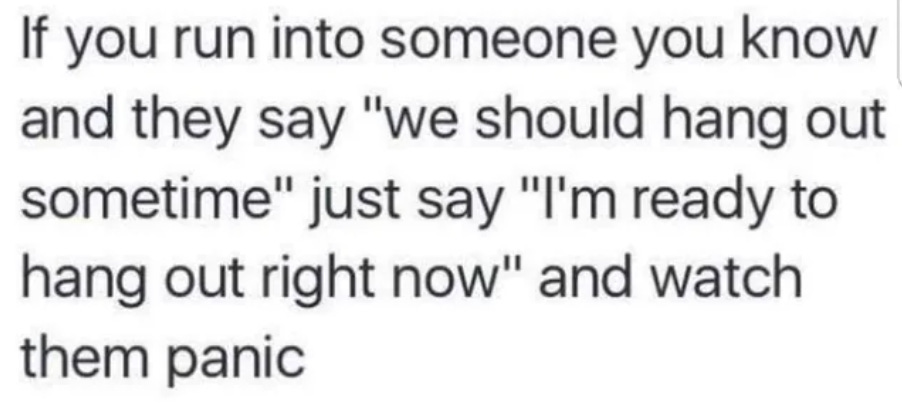
So my default internal script goes: “I should be better at following up.”
And if you’re a maximizer like me, the solution orients towards “more.”
More effort. More trying. More friends.
What if new friends are optional?
Trick question: how many more new friends do you want to make?
Is it 1? 10? 100?
“Making more friends” is an unbounded number that goes towards infinity.
(Kind of like how money can become a vacuum of meaning; we don’t know how much exactly we need; we just want more money.)
Once I realized this framework was built on scarcity, I had to ask myself a higher order question:
Who do I want to draw into my life?
And I couldn’t answer that. And to be honest, I still don’t quite know. I probably have a better idea of who I don’t want in my life.
But at least I can relieve myself of the obligation of having to make new friends. To not treat it like work. To accept that making new friends is optional.
And that creates a space for emergence.
Follow your interests
I’ve noticed that when new acquaintances have suggested we hang out, and don’t follow up, I don’t think any less of them. Maybe “we should hangout sometime” is pleasantry shorthand for “it’d be nice to see you more, but we don’t know how much we’d go out of our way to make that happen.”
And that is okay. Why create superfluous mental weight with fleeting connections?
What’s worked better for me is to identify the sense of guilt & obligation that comes with potential new friendships. In hippie terms, this is an energy leak.
I’d rather harvest that energy and put it towards my existing friendships, or new connections that have momentum, that are in the path of my interests.
I love the advice that “the best way to be an interesting person is to be interested.”
To that end, the best approach to friendship I’ve found for myself – at least in this season of life – is to follow my interests.
When I follow my interests, that naturally leads me to be interested in people.
Instead of courting all potential friendships in pickleball, I’ve started engaging with a dedicated group of players that has organically formed. There’s 6 of us who decided to sign up for a competitive league.
(It helps tremendously that we have a masternode, my nerdy term for social connectors who are good at organizing people.)
I don’t know if we’ll all become good friends, and it feels freeing to accept that we might not.
But for now, I’m happy to just follow my interests.
Warmly,
Oz
There is so much more I want to say around friendships and relationships in general. If you’re of the same mind, give me a signal boost with a subscribe, comment or share.
Asides and clarifications
- I suspect that most people have at least a few friends they can call on, and that while the trend towards zero friends is alarming, I don’t really buy that at scale. But if you really do think you have no friends, then I feel for you, and you can probably do better to try to make friends with more earnestness, and not read articles like this which is predicated on someone who already has friends and feels unchecked pressure to make more.
- Going off of point 1, I also suspect that most people want more social time rather than more friends, but the two can get conflated. Which brings me to…
- Quality > quantity. Going through the thought exercise in this article has made me more appreciative of my existing friendships.
- For maximizers/optimizers that feel like more is better, consider your existing pool of friends and where you can reinvest in, versus spreading oneself thin.
- It’s surprised me that I can enjoy my discernment around new connections (deciding who to give energy to) just as much as I enjoy new connections themselves. While this is meta, it helps me carve out internal space from the scarcity/obligation tendencies with friendships.